
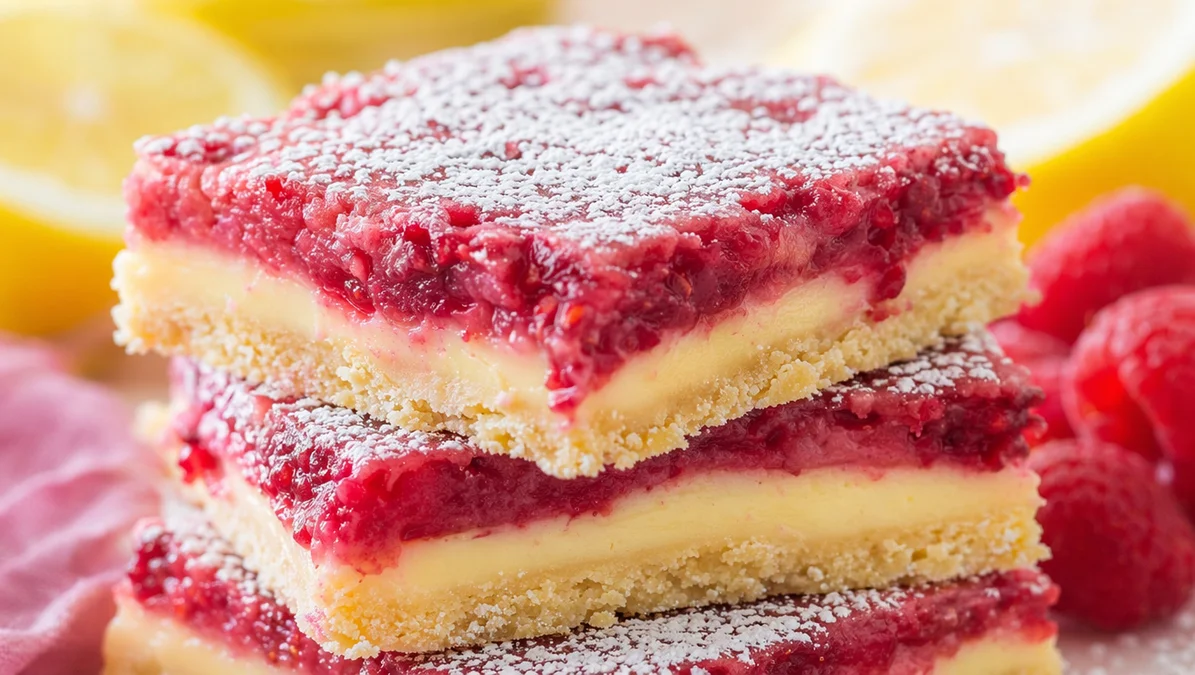
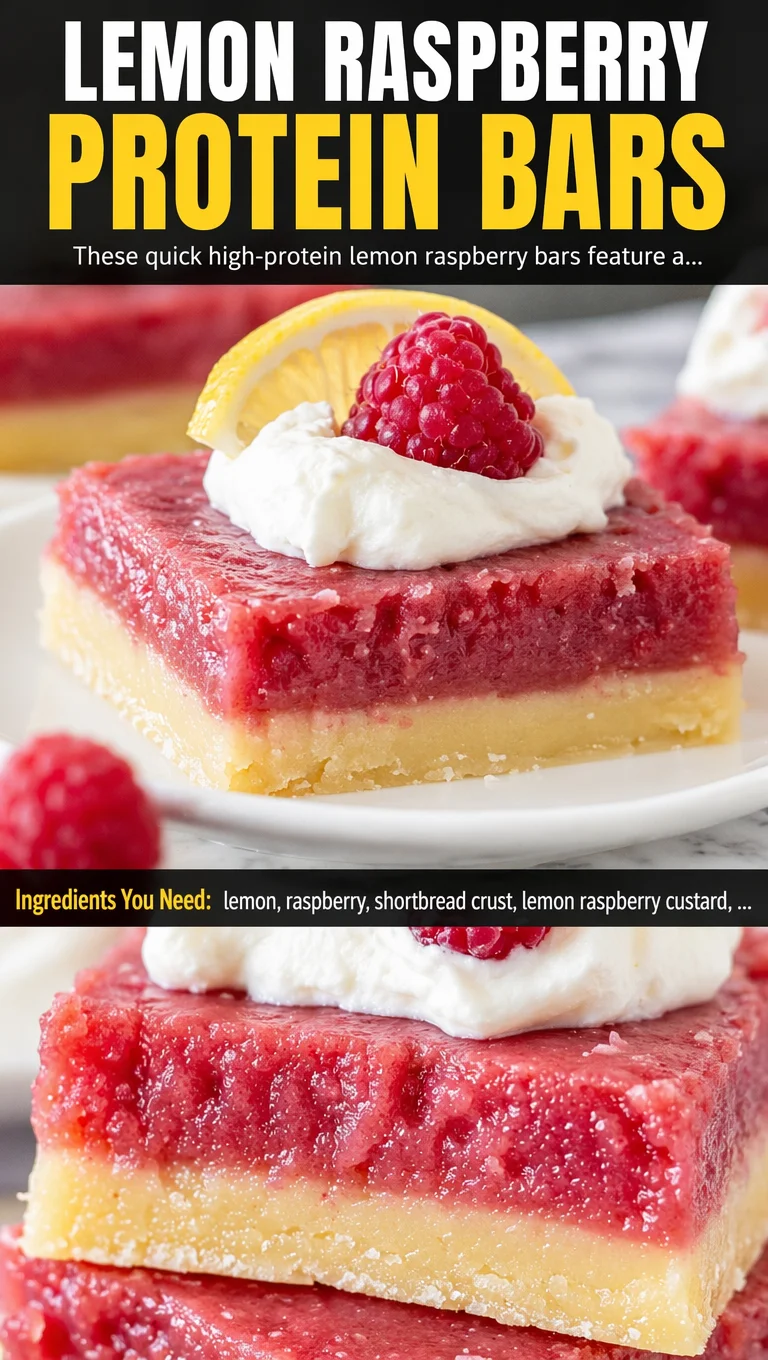
These quick high-protein lemon raspberry bars feature a buttery shortbread crust and tangy lemon raspberry custard. A macro-friendly dessert ready in under 30 minutes!
Ingredients
Instructions
Preheat your oven to 350°F (175°C). Line an 8×8-inch baking pan with parchment paper, leaving some overhang on two opposite sides to make lifting the bars out easy later. The parchment acts like a sling, so you can pull the entire block of bars out cleanly without scratching your pan. If you don’t have parchment, you can grease the pan thoroughly with butter or non-stick spray, but parchment is highly recommended for clean squares. While the oven heats, gather your ingredients and let the butter and eggs come to room temperature if you have time; this ensures even mixing and a tender crust.
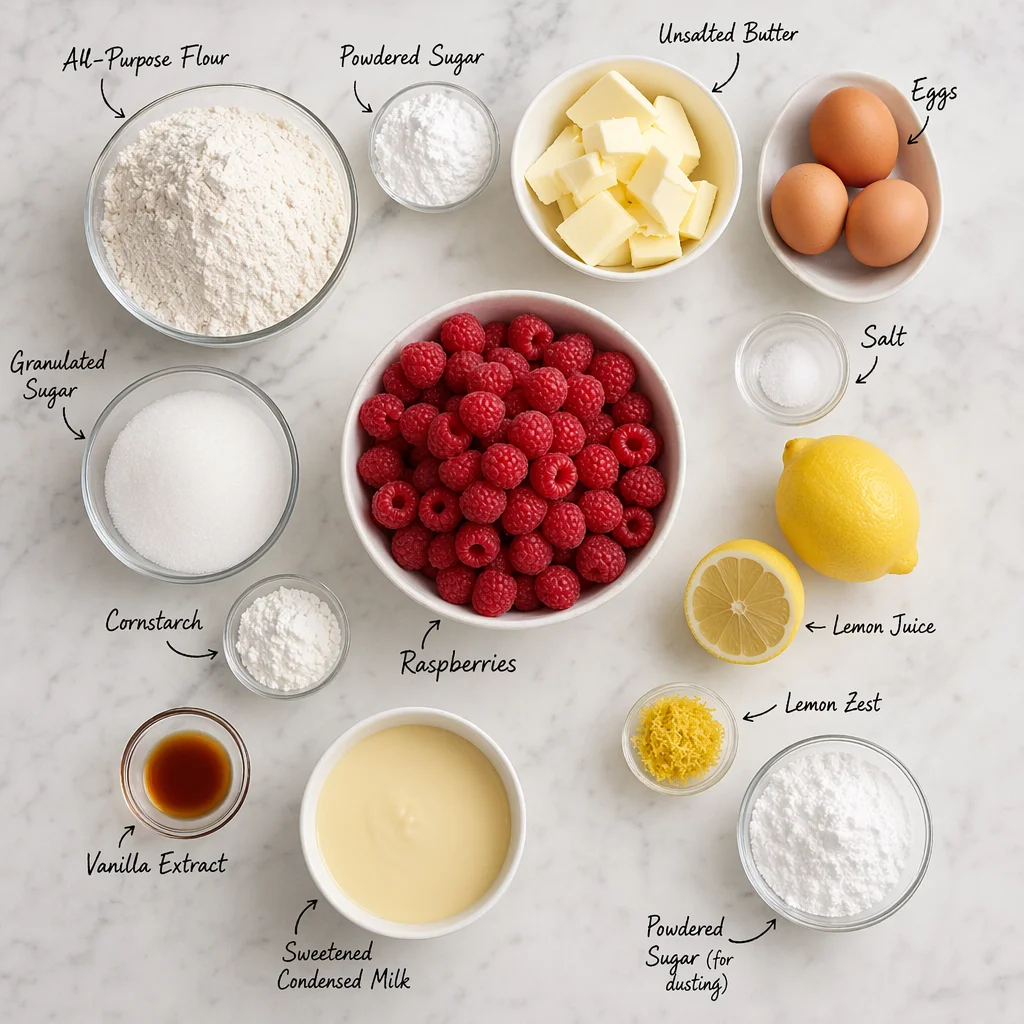
Make the shortbread crust: In a medium bowl, combine almond flour, vanilla protein powder, and coconut sugar. Whisk until evenly distributed, breaking up any clumps of protein powder. Add the cold cubed butter. Using a pastry cutter, fork, or your fingertips, work the butter into the dry ingredients until the mixture resembles coarse sand with some pea-sized butter pieces remaining. This creates a flaky, tender crust—the small butter bits melt in the oven, creating pockets of air. Add the 1 large egg and mix gently with a fork until a dough forms. It should be slightly sticky but hold together when pressed. If it’s too dry, add 1 teaspoon of cold water; if too wet, add a tablespoon of almond flour. Press the dough evenly into the prepared pan, using your fingers or the bottom of a glass to compact it firmly. An even thickness is crucial for uniform baking. Prick the crust all over with a fork (this prevents bubbling). Bake for 10-12 minutes, until the edges are lightly golden and the center is set but not browned. Remove from oven and let cool slightly on a wire rack while you prepare the filling. The crust will continue to firm up as it cools.
Prepare the lemon raspberry custard: In a medium saucepan, whisk together fresh lemon juice, lemon zest, granulated sweetener, 2 large eggs, and cornstarch until smooth. Make sure there are no lumps of cornstarch; a slurry-like consistency is key. Place the saucepan over medium heat and cook, stirring constantly with a whisk or rubber spatula, until the mixture thickens and begins to bubble. This takes about 5-7 minutes. You’ll know it’s ready when it coats the back of a spoon and leaves a clear trail when you run your finger through it. The mixture will go from thin to suddenly thick, so keep stirring to prevent scorching. Once thickened, remove from heat and gently fold in the raspberries. The heat will soften them slightly, creating beautiful ruby swirls. Do not overmix; you want pockets of whole berries for texture. Pour the custard over the pre-baked crust and spread evenly with a spatula.
Bake the assembled bars: Return the pan to the oven and bake at 350°F (175°C) for another 12-15 minutes, until the custard is set around the edges but still slightly jiggly in the center. It will continue to set as it cools. The top should be lightly golden and the raspberries may have released some juice, creating a marbled effect. Avoid overbaking, which can cause the custard to curdle or become rubbery. Remove from oven and place on a wire rack to cool completely at room temperature (about 1 hour). For cleaner slices, refrigerate for at least 2 hours or overnight. The chilling step firms up the custard and makes cutting precise squares much easier. Once fully chilled, use the parchment overhang to lift the entire slab onto a cutting board. Use a sharp knife to cut into 16 bars, wiping the blade clean between cuts for neat edges.
For best results
- For the best texture, use a high-quality vanilla protein powder that is not overly chalky. Whey isolate or a plant-based blend with a fine grind works well. If your protein powder is very sweet, you may reduce the added sweetener slightly. Taste the dough before pressing—it should be pleasantly sweet but not cloying. Store protein powder in an airtight container to prevent clumping; if lumps form, sift it with the dry ingredients.
- Fresh lemon juice is non-negotiable for that bright, tangy flavor. Bottled juice often contains preservatives that can impart a metallic taste and may not thicken properly due to added citric acid. Zest the lemons before juicing—the oils in the zest carry intense lemon aroma. Use a microplane for fine zest; avoid the white pith, which is bitter.
- If using frozen raspberries, do not thaw them first. Add them directly to the hot custard; the residual heat will gently thaw them without turning the mixture watery. Frozen berries are often more tart, which complements the sweet custard nicely. If you prefer a sweeter result, toss the frozen berries with a teaspoon of sugar before folding in.
- To achieve perfectly clean squares, chill the bars thoroughly. Use a long, sharp chef's knife and cut with a single smooth motion—no sawing. Wipe the blade with a damp paper towel between cuts to remove sticky residue. For extra neatness, dip the knife in hot water and dry it before each cut.
- These bars are naturally gluten-free (using almond flour) and can be made dairy-free by substituting the butter with a high-quality vegan butter stick (not spread). Coconut oil works too, but it will add a slight coconut flavor. For a nut-free version, replace almond flour with oat flour (certified gluten-free if needed) and increase the butter by 1 tablespoon, as oat flour absorbs more moisture.
- Storage: Keep leftover bars in an airtight container in the refrigerator for up to 5 days. They can also be frozen for up to 2 months. To freeze, arrange bars in a single layer on a baking sheet and freeze until solid (about 1 hour), then transfer to a freezer-safe bag or container with parchment between layers. Thaw in the refrigerator overnight or at room temperature for 30 minutes before serving.
Variations
- Blueberry Lemon Bars: Substitute raspberries with fresh or frozen blueberries. Blueberries have a milder sweetness and pair beautifully with lemon. You may need to increase the sweetener by 1-2 tablespoons because blueberries are less tart than raspberries. The custard will take on a lovely lavender hue.
- Vegan Version: Replace the eggs in the crust with a flax egg (1 tablespoon ground flaxseed + 3 tablespoons water, let sit for 5 minutes). For the custard, use a combination of 1/4 cup cornstarch and 1 cup full-fat coconut milk (from a can) plus 1/4 cup lemon juice. Cook as directed; the coconut milk adds richness. Use a vegan protein powder and vegan butter. Note that the texture will be slightly softer but still delicious.
- High-Protein Boost: Add 1 scoop (30g) of unflavored collagen peptides to the custard mixture for an extra 10g of protein per bar. Collagen dissolves easily without affecting flavor or texture. You can also mix a tablespoon of chia seeds into the custard for added fiber and omega-3s.
- Low-Carb / Keto Adaptation: Replace the coconut sugar in the crust with a brown sugar substitute (like Swerve) and use a keto-friendly sweetener in the custard (allulose or erythritol blend). Ensure your protein powder is low-carb (most are). Each bar will have about 4g net carbs. The texture will be slightly more crumbly due to the lack of sugar, but still satisfying.
- Lemon Poppy Seed Bars: Omit the raspberries and add 2 tablespoons of poppy seeds to the custard along with an extra tablespoon of lemon zest. The poppy seeds add a delightful crunch and nutty flavor. This version is perfect for those who prefer a pure lemon experience.
Nutrition
- Calories185 kcal
- Total Fat11g
- Saturated Fat4g
- Cholesterol55mg
- Sodium120mg
- Total Carbohydrates16g
- Dietary Fiber3g
- Sugars8g
- Protein12g