
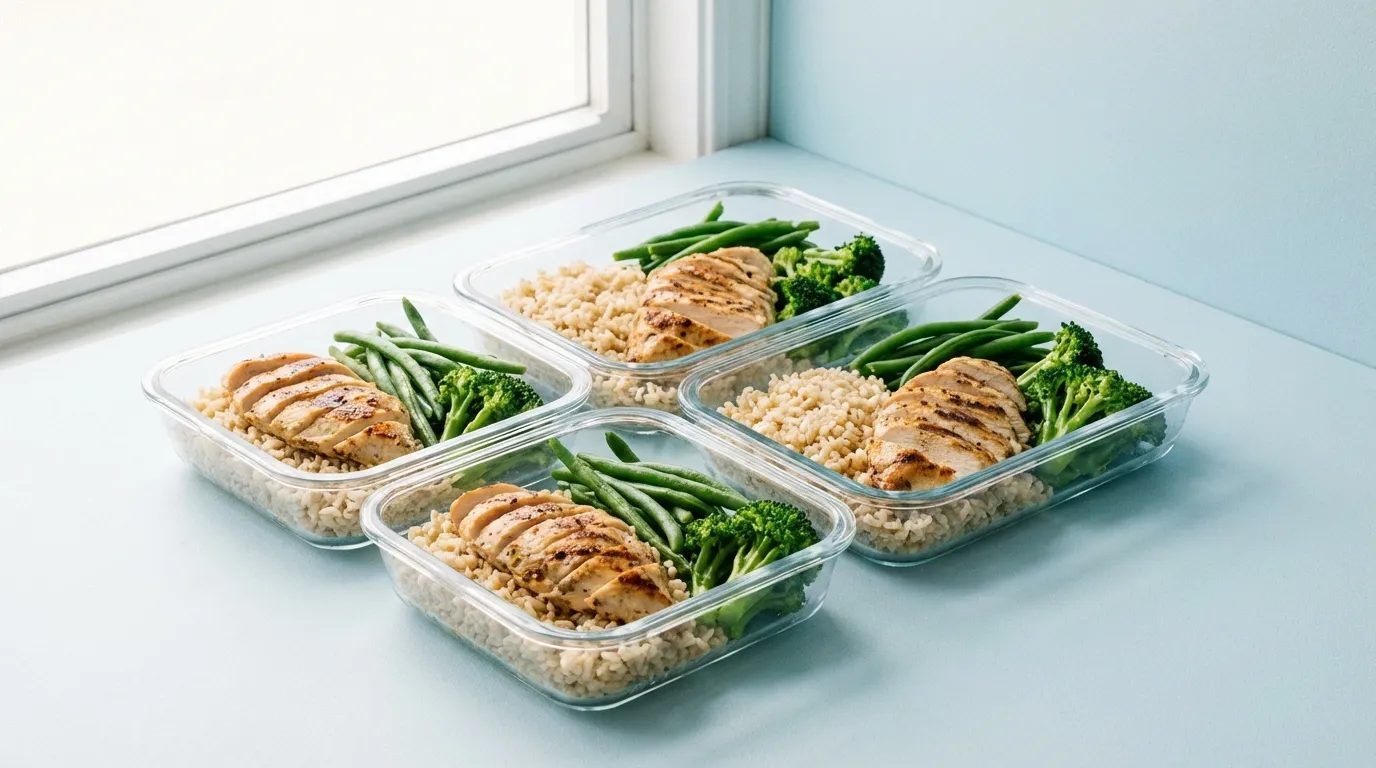
The Sunday Reset Philosophy: Why Efficiency Equals Consistency
The Sunday Reset is a systematic meal preparation framework that uses modular task automation to eliminate decision fatigue and ensure consistent daily protein intake. By dedicating 60 minutes to batch-cooking, you secure five high-protein lunches, maintaining a baseline of at least 30 grams of protein per meal to support metabolic health.
In my ten years working in sports nutrition, I have watched thousands of athletes and busy professionals fail at their dietary goals not from a lack of willpower, but from a lack of systematic execution. When you leave your lunch choices to chance on a Wednesday afternoon, you are fighting an uphill battle against convenience culture. The Sunday Reset is designed to strip away the emotion and the guesswork from your weekly nutrition.
Consistency is the hidden macro of bodybuilding and sustainable fat loss. You cannot out-train a diet that fluctuates wildly between 50 grams and 150 grams of protein from day to day. By dedicating exactly 60 minutes on a Sunday to batch-cook your core nutritional anchors, you guarantee that your baseline requirements are met before the work week even begins. This system is not about creating gourmet, complex dishes that require constant babysitting at the stove. It is about deploying a repeatable, stress-free workflow that yields five high-performance meals.
To maintain a 150g+ daily protein intake without suffering from kitchen burnout, we have to change how we view cooking. We are not cooking individual meals; we are manufacturing nutrition. By standardizing your approach, you reclaim hours of your week and remove the psychological friction associated with healthy eating.
{{IMG:pillar4_5_days_lunch_img1.webp}}
The Parallel Cooking Framework: How to Own the Hour
The Zone Method is a parallel processing technique that utilizes three distinct heat sources simultaneously to complete meal prep within a 60-minute window. By delegating proteins, grains, and vegetables to the oven, stovetop, and air fryer concurrently, you eliminate sequential waiting times and ensure all components finish at the same interval.
Most people approach meal prep linearly: they cook the chicken, then they cook the rice, and finally, they steam the broccoli. This sequential processing is a massive waste of time. To execute a five-day prep in exactly 60 minutes, you must utilize parallel cooking. This means your oven, your stovetop, and your air fryer must be running concurrently, each handling a different macronutrient component of your meal.
- Zone 1 (Oven): This is your bulk protein engine. Load 2.5 pounds of chicken breast or lean ground turkey onto a heavy-duty sheet pan. Set the temperature to 400°F. Once the meat goes in, the cooking time is 25 minutes.
- Zone 2 (Stovetop): This is your complex carbohydrate station. Boil water for grains like brown rice or quinoa immediately after the protein enters the oven. Monitor only at the beginning and end of the cycle.
- Zone 3 (Air Fryer): This is your rapid micronutrient processor. Roast fibrous vegetables like broccoli, asparagus, or Brussels sprouts for 10–12 minutes at 400°F for a crispy texture without excess oil. For a deep dive into maximizing this appliance for a mix and match protein prep, ensure you are utilizing the basket’s full volume to prevent overcrowding.
{{IMG:pillar4_5_days_lunch_img2.webp}}
By establishing these three zones, you create a kitchen workflow where the machinery does the heavy lifting, allowing you to focus purely on assembly and portioning.
Essential Gear for Macro-Precision
Precision requires the use of standardized measurement tools to eliminate nutritional estimation errors and maintain food integrity. A digital food scale is required for gram-accurate portioning, while borosilicate glass containers prevent chemical leaching and flavor degradation, ensuring that stored meals maintain their quality through the fifth day of the work week.
If you are serious about altering your body composition, guessing your portion sizes is the fastest route to stagnation. A chicken breast can range anywhere from four to ten ounces, representing a massive variance in your daily caloric and protein intake.
{{IMG:pillar4_5_days_lunch_img4.webp}}
- Digital Food Scale: This is the most important tool in your kitchen. Weighing your food in grams provides the protein-per-gram accuracy required for strict macro-tracking. Weigh proteins after cooking, as meat loses approximately 25% of its weight in water during the process.
- Glass Airtight Containers: Transitioning from plastic to borosilicate glass is a game-changer for meal prep. Glass is BPA-free, leak-proof, and microwave-safe. It does not absorb odors or stains, ensuring that your Thursday lunch tastes as fresh as it did on Sunday.
- Vacuum Sealer (Pro Tip): If you struggle with the texture of food on days four and five, a vacuum sealer is a worthy investment. By vacuum-sealing your final two meals, you completely halt oxidation, locking in moisture and preventing “warmed-over” flavor.
Why Pan Material and Tool Quality Matters
Performance in the kitchen is directly tied to heat distribution, which requires heavy-gauge stainless steel or cast iron to prevent uneven searing and hot spots. For air frying, silicone liners are essential tools that increase surface area coverage and simplify cleanup, allowing you to remain within your 60-minute constraint.
Thin, cheap baking sheets warp under high heat and create hot spots, leaving you with chicken that is burnt on the edges and raw in the center. Invest in half-sheet commercial aluminum pans. When utilizing your air fryer, custom-fit silicone liners not only protect the non-stick coating of the basket but also allow you to lift the cooked vegetables out in one swift motion, cutting your cleanup time in half.
Cost and Efficiency: The Macro-Budget Analysis
High-protein meal prep is an economical strategy that reduces food costs to under three dollars per serving through bulk purchasing and systematic batch-cooking. By prioritizing lean proteins and grains in large quantities, you can achieve a 150-gram daily protein intake while saving an average of 60 to 80 dollars per week compared to takeout.
There is a persistent myth that bodybuilding and fitness nutrition are inherently expensive. Elena Vasquez, our Co-Founder and Nutrition Strategist, built her entire methodology around dismantling this idea. When you apply basic budget planning and batch economy to your grocery shopping, hitting 150 grams of protein a day becomes incredibly affordable.
- Protein Per Dollar: Lean ground turkey (93/7) and liquid egg whites offer the highest protein-to-cost ratio. For a practical application of this metric, review our batch-cooked high-fiber cabbage soup routine.
- Weekly Savings: The average takeout lunch costs between $12 and $15. Prepping your own lunches for $3 a serving saves you thousands of dollars annually.
- Batch Economy: Purchase complex carbohydrates like jasmine rice, brown rice, or rolled oats in 10-pound or 20-pound bulk bags to reduce your per-serving cost by nearly 40%.
{{IMG:pillar4_5_days_lunch_img5.webp}}
Performance Optimization: Macro-Tracking and Muscle Support
Macro-tracking is the practice of quantifying caloric and nutrient intake to ensure muscle protein synthesis through a consistent 30-to-40 gram protein threshold per meal. By pairing lean proteins with low-glycemic complex carbohydrates, you stabilize blood glucose levels, preventing the afternoon energy crashes associated with refined carbohydrates.
Every meal you pack should be engineered with a specific physiological goal in mind. If you are training hard, your body requires a consistent influx of amino acids to repair and build muscle tissue. This is the foundation of the 40g Protein Rule.
- Macro Tracking Accuracy: Always track your macros based on the state of the food when you weigh it. If you weigh your chicken raw, use the raw nutritional data. If you weigh it cooked, use the cooked data. Consistency in your measuring protocol prevents hidden caloric surpluses.
- Glycemic Balance: A high-protein lunch is useless if it puts you to sleep at your desk by 2:00 PM. Pair your lean proteins with slow-burning, low-glycemic complex carbs like brown rice, quinoa, and sweet potatoes to provide a steady release of glucose into your bloodstream.
{{IMG:pillar4_5_days_lunch_img6.webp}}
Core Protein Bases: The 150g Weekly Anchor
A 150-gram protein anchor is a nutritional baseline strategy that ensures you consume 30 grams of complete protein per meal throughout the week. To maintain optimal texture during reheating, apply a 15-minute salt and water brine to lean proteins, which triggers osmosis to retain moisture within the muscle fibers.
Dry, rubbery chicken breast is the number one reason people abandon their meal prep by Wednesday. This happens because lean proteins have very little intramuscular fat to keep them juicy during the reheating process.
- Brining Science: Submerge chicken breasts or pork chops in a solution of 1/4 cup kosher salt to 4 cups of warm water for 15 minutes. The salt denatures the meat’s proteins, causing them to swell and pull moisture deep into the muscle fibers, which remains trapped even after microwaving.
- Target Temperatures: Use a digital instant-read thermometer to ensure safety and quality. Pull your chicken breasts from the oven exactly at 165°F. For lean ground turkey, ensure the internal temperature reaches 165°F to prevent the meat from turning into dry, unpalatable crumbles.
{{IMG:pillar4_5_days_lunch_img7.webp}}
Carb and Fiber Foundations for Sustained Energy
Carb and fiber foundations are the volumetric components of a meal that provide satiety and energy stability through the inclusion of 8 to 10 grams of fiber per serving. By utilizing slow-digesting carbohydrates like par-boiled brown rice and quinoa, you maintain structural integrity during the five-day storage period, preventing the mushy texture common in refined starches.
Anti-inflammatory food choices and high-fiber vegetables are critical for digestion, especially when consuming a high-protein diet. Fiber adds physical bulk to your stomach, triggering stretch receptors that signal fullness to your brain without adding excessive calories. When constructing your carb foundation, think about the reheating process. Pasta can become mushy, and certain potatoes can become grainy. Par-boiled brown rice and quinoa hold their structural integrity exceptionally well over a five-day period.
The 60-Minute Execution Timeline
The 60-minute execution timeline is a timestamped mise en place workflow that coordinates oven, stovetop, and air fryer usage to maximize output. By starting with the longest cook-time items first and utilizing downtime for cleanup and portioning, you ensure a zero-downtime prep session.
| Minute | Action Item | Heat Source |
|---|---|---|
| 00-10 | Protein Brining & Veggie Chopping | N/A |
| 10-15 | Preheating & Grain Start | Stovetop |
| 15-45 | Main Protein & Veggie Roast | Oven/Air Fryer |
| 45-55 | Cooling & Macro-Portioning | Scale |
| 55-60 | Cleanup & Storage | N/A |
{{IMG:pillar4_5_days_lunch_img3.webp}}
During minutes 15 through 45, while the oven and stovetop are working, you are not sitting down. You are actively managing the air fryer, preparing your storage containers, and wiping down cutting boards. This dense, focused period of work is what buys you freedom from Monday to Friday.
Flavor Fatigue Solutions: The Sauce-on-the-Side Rule
The Flavor Pod method is a culinary strategy that involves preparing a neutral protein base and applying distinct, calorie-controlled sauces at the time of consumption. By using small, two-ounce ramekins for sauces, you prevent flavor fatigue and maintain the ability to customize your meal profile daily without extra cooking.
If you cover five days’ worth of chicken in heavy BBQ sauce on Sunday, you will despise BBQ sauce by Thursday. Instead, season your bulk proteins with a versatile, neutral blend: kosher salt, coarse black pepper, garlic powder, and a touch of smoked paprika.
Once your neutral base is portioned into your glass containers, utilize small, two-ounce plastic ramekins—these are your Flavor Pods. This strategy is essential when preparing 5-day chicken burrito bowls, where the sauce determines the daily theme. Monday could be a Greek yogurt tzatziki. Tuesday might be a soy-ginger glaze. Wednesday can feature a macro-friendly hot sauce and fresh lime squeeze. You control the calories by measuring the sauce into the pod, and you completely eliminate flavor fatigue.
{{IMG:pillar4_5_days_lunch_img8.webp}}
Scaling for Your Goal: Hypertrophy vs. Fat Loss
Scaling is the process of adjusting carbohydrate and fat portions based on your training phase while keeping the protein base constant to meet specific caloric requirements. By utilizing a scaling matrix, you can shift between surplus for muscle hypertrophy and deficit for fat loss without altering your core meal prep routine.
Your protein requirement remains static regardless of your goal; it is the structural anchor of your diet. What fluctuates is your energy intake—specifically, your carbohydrates and fats.
| Goal | Carb Portion | Fat Portion | Fiber Volume |
|---|---|---|---|
| Hypertrophy (Surplus) | 1.5 cups | 1 tbsp (oil/seeds) | Moderate |
| Maintenance | 1 cup | 0.5 tbsp | High |
| Fat Loss (Deficit) | 0.5 cup | 0 tbsp | Maximum |
If you are in a cutting phase, do not simply remove the rice and leave the container half empty. Replace that lost carbohydrate volume with maximum fiber volume—pack the container with extra roasted spinach, zucchini, or green beans to trick your stomach into feeling completely full on fewer calories.
Storage Science: The 5-Day Freshness Protocol
The 5-Day Freshness Protocol is a food safety and quality management system that requires cooling food to below 40°F before sealing to prevent condensation and bacterial growth. By spreading food on baking sheets to dissipate steam, you maintain optimal texture and prevent the sogginess that occurs when hot food is trapped in airtight containers.
Food safety is paramount when prepping for five days. The “Danger Zone” for bacterial growth is between 40°F and 140°F. Your goal is to move your cooked food through this temperature window as rapidly as possible. Spread your cooked proteins and grains out on a baking sheet to increase surface area and accelerate the cooling process. Once the food has stopped releasing visible steam and is cool to the touch, portion it into your glass containers. Seal the lids tightly and immediately transfer them to the coldest part of your refrigerator.
Frequently Asked Questions
Question: Can I freeze these meals?
Answer: Yes, but prioritize freezing your complex grains and ground proteins like turkey or beef. If you are looking for long-term storage options, consider incorporating freezer-friendly breakfast burritos into your rotation alongside these chilled lunches. Whole chicken breasts tend to undergo cellular damage during the freezing process, which results in a highly degraded, spongy texture when thawed.
Question: How do I prevent my rice from getting hard?
Answer: Rice starches crystallize in the refrigerator. To reverse this, add one tablespoon of water to your container and drape a damp paper towel over the top before microwaving. The steam generated will rehydrate the grains perfectly, restoring the original texture and preventing the rice from becoming dry or grainy.
Question: Is 5-day chicken safe to eat?
Answer: Yes, provided your storage protocol is flawless. If the chicken was cooked to an internal temperature of 165°F, cooled rapidly, and stored continuously in airtight glass containers at 40°F or below, it is perfectly safe to consume on Friday. Always check for signs of spoilage before consumption.
{{IMG:pillar4_5_days_lunch_pinterest.webp}}
Final Conversion and Next Steps
You now have the complete system—now apply it to the recipes. Visit our database to choose your protein base and begin your first 60-minute cycle for a week of optimized nutrition.
Execution is the only thing standing between you and your macro goals. Grab your digital scale, clear your kitchen counters, and commit to mastering this one-hour workflow.
- Action: Download the Sunday Reset Shopping List to streamline your grocery run.
- Next Step: Ready to start? Explore our exact step-by-step 5-day chicken burrito bowls recipe to test your first parallel cooking session.
- Internal Link: To round out your nutritional plan, see our guide on structured snack box prep to maintain energy levels between meals.
{{IMG:pillar4_5_days_lunch_img3.webp}}